
How many e-rickshaws can one depot charger serve overnight?the unit is Ah per night, not vehicles per charger
The answer first. Inside an 11-hour usable night window, a 20A charger refills one 150Ah pack (about 7.5 h) or two 100Ah packs (about 5 h each); a 30A unit manages two 150Ah packs or three 100Ah packs. A 10A unit cannot finish a 150Ah pack (15 h) or a 200Ah pack (20 h) at all — which is why depots that bought the cheapest charger drive out in the morning on 70–80% packs. The only reliable planning figure is charger current × usable hours ÷ that pack’s own charge time. The table, the kW per bay and the nightly consumption below are all derived from it.
verifiedCharge times are the ex-works calibration figures published on our charger page, already including the constant-voltage tail and end-of-charge trickle; capacity steps and pack weights come from the model matrix. Cycles per night, kW per bay and nightly consumption are arithmetic on those two published bases and are labelled as computed, so you can re-run them with your own current steps and window.
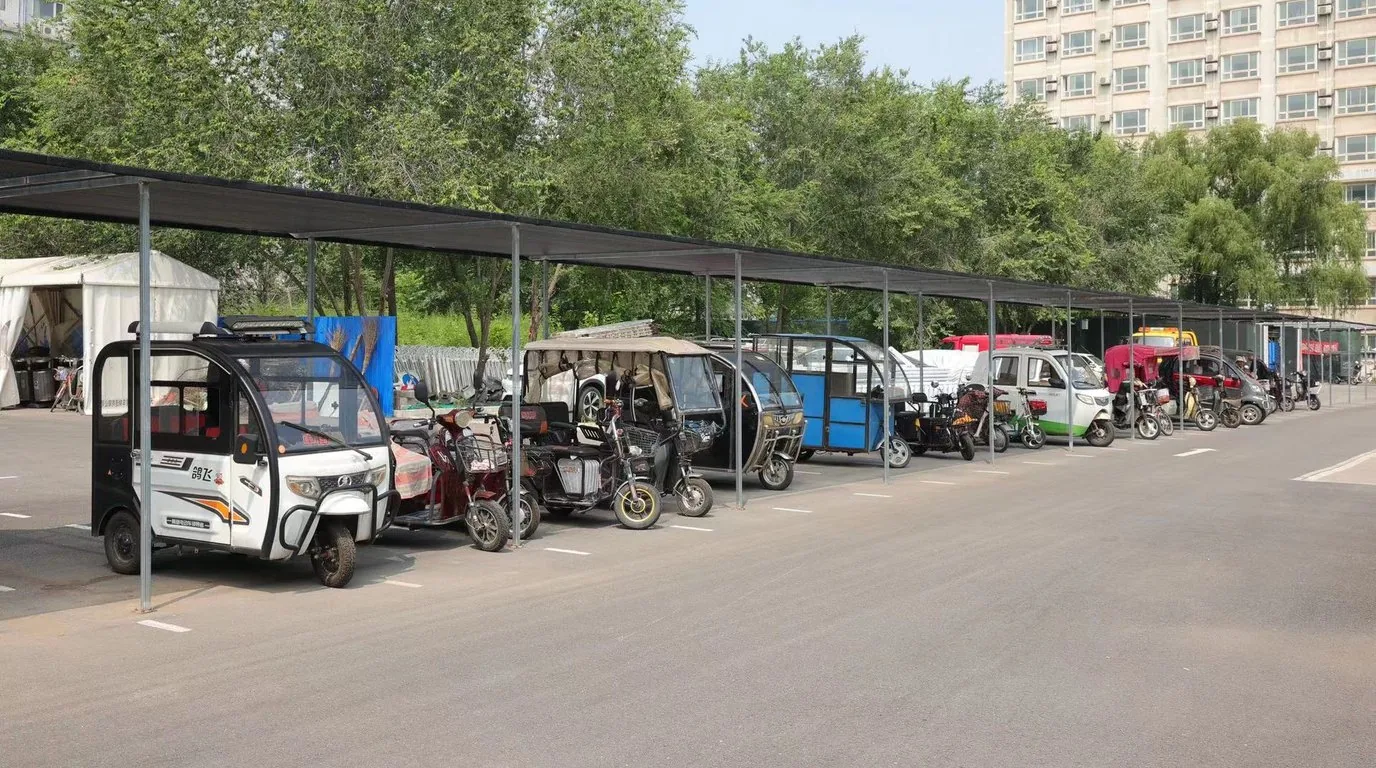
How many packs will one charger actually refill in a night?
A 12-hour night is an 11-hour window
On 20A: one 150Ah pack, or two 100Ah packs
Why 10A is the trap
30A buys bays, not energy
Capacity against current: how many cycles fit an 11-hour window?
The last column is the decision. Each duration is the calibrated figure published on our charger page (CV tail included); cycles = 11 ÷ that duration, rounded down. Rounding down is not caution — an unfinished cycle is not capacity, and pulling the plug mid-way also throws away the balancing window.
| Pack capacity | 10A (≈0.1C) | 20A | 30A (≈0.3C) | Cycles per night (11 h) |
|---|---|---|---|---|
| 100Ah | ≈ 10 h | ≈ 5 h | ≈ 3.5 h | 1 / 2 / 3 |
| 150Ah | ≈ 15 h — over the window | ≈ 7.5 h | ≈ 5 h | 0 / 1 / 2 |
| 200Ah | ≈ 20 h — over the window | ≈ 10 h | ≈ 7 h | 0 / 1 / 1 |
Full-charge voltage has to match the series count: 16S (the 48V and 60V platforms, 51.2V nominal) charges to 58.4V and 24S (the 72V platform, 76.8V nominal) to 87.6V. Lowering the current cannot correct a voltage mismatch, and one charger can never serve two series counts. Pack weights for each capacity step are on the 48V / 60V / 72V model matrix.
Aviso sobre especificaciones:Las cifras anteriores son valores de referencia de ingeniería. Pueden diferir según el lote de producción, la configuración y el ciclo de trabajo real, y los porcentajes de vida útil, eficiencia, disponibilidad y cobertura son estimaciones de ingeniería y referencias de banco. Contáctenos para obtener la hoja de especificaciones detallada.
How many kilowatts does a depot of bays need?
Per-bay power = full-charge voltage × charge current
Site load is about simultaneous bays, not the fleet
Input voltage: depots need a different specification
What disturbs the timetable once the depot is running?
The capacity above assumes temperature, grid and handshake are all normal. Tropical summers, weak grids and depots that kept the old lead-acid chargers break all three at once — so the bay count should carry margin over the arithmetic, not sit exactly on it.
- 01device_thermostat
Heat: derate from 45℃, stop at 55℃
In tropical and Middle Eastern summers a bay passes 45℃ easily. The firmware carries adaptive thermal limits: stepped derating to 0.5C above 45℃ and a mandatory stop at 55℃, with trickle recharge only once natural ventilation brings the pack back below 45℃. A cycle that took 7.5 h becomes 10 h or more — and a 30A depot that planned two cycles a night is down to one.
Derate 45℃ / stop 55℃ - 02power_off
Low voltage steals hours silently
The night peak pulls the tail of the feeder down, the charger reaches its constant-power band and the current stops rising, and the gauge shows nothing wrong. That is the source of “same vehicle, same charger, sometimes seven hours, sometimes nine”. On weak grids specify to the 90–265V field figure and put at least 20% margin into the schedule.
Schedule with 20% margin - 03sync
Handshake: above 30A the CAN bus is not optional
The BMS is master of the current: it publishes the permitted charge current from the highest cell voltage, the lowest and ambient temperature. Under CAN control that refreshes every 100 ms and any abnormal delta or over-temperature forces a cut within 50 ms; without the communications line the charger stays in a high-impedance zero-volt state and never starts. Low-power vehicles can use a fail-safe voltage-sensing charger, but fast charging at 30A and above must run on CAN.
≥30A on CAN - 04dangerous
The old lead-acid charger cannot stay in the yard
A lead-acid unit carries a high-voltage equalisation and float stage that sits well above LiFePO4 saturation, and sustained over-voltage swells cells. In our own figures over 70% of lithium fires and early failures come from a charger mismatch. A depot converting to lithium replaces its chargers as a batch.
Replace on conversion
When does charging stop being enough and swapping start?
The test: cycles × bays against daily demand
A worked depot: 20 vehicles, 150Ah, one shift
Send us these four lines
What do depot managers ask most about charging?
Can one charger charge two packs at once?expand_more
Is charging to 80% a night good enough?expand_more
Is 30A too much for a 100Ah pack?expand_more
Can 48V and 72V vehicles share one charging line?expand_more
Does every vehicle in the fleet need its own charger?expand_more
Send the fleet size, the capacity and the night window
Tell us the platform (48V / 60V / 72V), the pack capacity, how many packs must be full each night, the usable hours and the maximum ambient temperature. We return a bay schedule: number of units and current step, kW per bay, an estimate of the nightly draw, whether standby packs are needed, plus the matching pack datasheet and document list for your destination port.
- Sized on your window and capacity, not on the largest unit we can sell
- 85–265V wide-input standard, 140–280V specification for concentrated depot charging
- Series count, plug and destination socket checked before shipment, compliance file in the same container
Aviso sobre especificaciones:Las cifras anteriores son valores de referencia de ingeniería. Pueden diferir según el lote de producción, la configuración y el ciclo de trabajo real, y los porcentajes de vida útil, eficiencia, disponibilidad y cobertura son estimaciones de ingeniería y referencias de banco. Contáctenos para obtener la hoja de especificaciones detallada.