
Aller au contenu principal
verifiedAIS-156 | UN38.3 | CE | IEC 62619 | Système de certification des exportations sur 12 marchés
FR
TIANQIUExportation Li-ion
Depot charging capacity · 10A / 20A / 30A tiers · no price amounts published11-hour usable window20A: one 150Ah pack per night10A: 150Ah never finishes16S 58.4V · 24S 87.6V

How many e-rickshaws can one depot charger serve overnight?the unit is Ah per night, not vehicles per charger

The answer first. Inside an 11-hour usable night window, a 20A charger refills one 150Ah pack (about 7.5 h) or two 100Ah packs (about 5 h each); a 30A unit manages two 150Ah packs or three 100Ah packs. A 10A unit cannot finish a 150Ah pack (15 h) or a 200Ah pack (20 h) at all — which is why depots that bought the cheapest charger drive out in the morning on 70–80% packs. The only reliable planning figure is charger current × usable hours ÷ that pack’s own charge time. The table, the kW per bay and the nightly consumption below are all derived from it.

bolt
20A · 16S full-charge voltage58.4V
timer
150Ah @20A≈ 7.5 h
battery_charging_full
100Ah @20A per night2 packs
ev_station
24S @20A per bay≈ 1.75 kW

verifiedCharge times are the ex-works calibration figures published on our charger page, already including the constant-voltage tail and end-of-charge trickle; capacity steps and pack weights come from the model matrix. Cycles per night, kW per bay and nightly consumption are arithmetic on those two published bases and are labelled as computed, so you can re-run them with your own current steps and window.
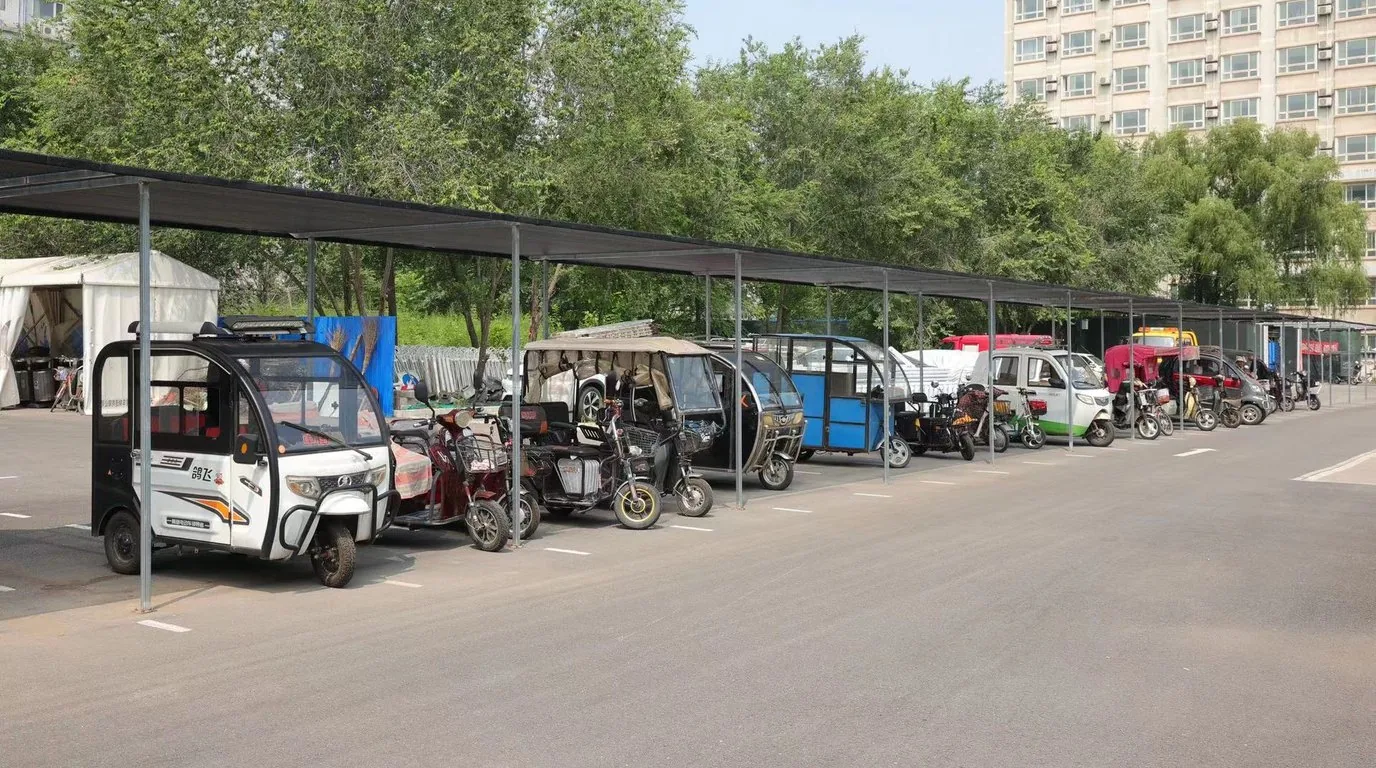
Rows of parked passenger e-rickshaws being charged overnight at a depot in Delhi
scheduleStep one · turning the night into hours

How many packs will one charger actually refill in a night?

A 12-hour night is an 11-hour window

Start with usable hours, not clock time. Collecting vehicles, queueing for a plug and pulling out for the morning run each take a slice: a 12-hour night shift usually leaves 11 hours of real charging time, and a two-shift depot running concentrated daytime charging has 5–6 hours instead. Every “how many vehicles per charger” answer has to start from that number — get the window wrong and every later decision is wrong with it.

On 20A: one 150Ah pack, or two 100Ah packs

On our published ex-works basis, a 150Ah pack needs about 7.5 h at 20A — one cycle fits an 11-hour window, a second does not; 100Ah needs about 5 h, so it turns exactly twice; 200Ah needs about 10 h, leaving under an hour after the first cycle, so it is effectively one. That is the real capacity of a 20A depot: per bay per night, one 150Ah pack, one 200Ah pack or two 100Ah packs.

Why 10A is the trap

A 10A charger is cheap on the invoice and expensive in the yard. A 150Ah pack takes 15 h at 10A and a 200Ah pack 20 h — both longer than the 11-hour window. This is not “charging a little slower”: the pack is never full, every night it leaves at 70–80%, and by mid-afternoon it dies early. Fleet managers then blame the battery; the current step was the fault. 10A belongs on packs below 100Ah, or on daytime top-ups.

30A buys bays, not energy

At 30A a 150Ah pack drops to 5 h (two cycles a night) and a 100Ah to 3.5 h (three), so the bay count roughly halves. Notice what does not change: the energy the depot must deliver is set by how many packs and how many Ah, not by the current step. 30A changes how many cycles fit and how many chargers run at the same moment — which is what sets peak kW. Above 30A the charge counts as fast charging and must run the CAN handshake, with the BMS publishing the permitted current in real time.
grid_onCycles per night

Capacity against current: how many cycles fit an 11-hour window?

The last column is the decision. Each duration is the calibrated figure published on our charger page (CV tail included); cycles = 11 ÷ that duration, rounded down. Rounding down is not caution — an unfinished cycle is not capacity, and pulling the plug mid-way also throws away the balancing window.

cycles = 11 h ÷ single-cycle time
Pack capacity10A (≈0.1C)20A30A (≈0.3C)Cycles per night (11 h)
100Ah≈ 10 h≈ 5 h≈ 3.5 h1 / 2 / 3
150Ah≈ 15 h — over the window≈ 7.5 h≈ 5 h0 / 1 / 2
200Ah≈ 20 h — over the window≈ 10 h≈ 7 h0 / 1 / 1

Full-charge voltage has to match the series count: 16S (the 48V and 60V platforms, 51.2V nominal) charges to 58.4V and 24S (the 72V platform, 76.8V nominal) to 87.6V. Lowering the current cannot correct a voltage mismatch, and one charger can never serve two series counts. Pack weights for each capacity step are on the 48V / 60V / 72V model matrix.

Avis sur les spécifications:Les chiffres ci-dessus sont des valeurs de référence techniques. Ils peuvent différer selon le lot de production, la configuration et le cycle de service réel, et les pourcentages de durée de vie, d'efficacité, de disponibilité et de couverture sont des estimations techniques et des références de banc. Contactez-nous pour la fiche technique détaillée.

boltStep two · what the yard pulls

How many kilowatts does a depot of bays need?

Per-bay power = full-charge voltage × charge current

Charger output is rated at full-charge voltage, not nominal. A 16S bay at 20A is about 1.17 kW (58.4V × 20A) and at 30A about 1.75 kW; a 24S bay at 20A is about 1.75 kW (87.6V × 20A) and at 30A about 2.63 kW. Those are pack-side figures — divide by the 90–95% end-to-end efficiency for the draw from the grid: roughly 1.9 kW per 24S/20A bay and 2.8 kW per 24S/30A bay. Computed from the published voltages, so you can re-check it against your own series count.

Site load is about simultaneous bays, not the fleet

The depot load is the number of bays charging at the same moment × per-bay power — not the number of chargers on the wall. Twenty bays at 24S/20A together draw about 38 kW; the same 20 vehicles on ten 30A bays run in two batches and peak near 28 kW, with the same nightly energy. Cables, breakers and the supply connection are sized on that peak, never on the average. This is site electrical design and must be checked by a licensed electrician against local code — we supply the load arithmetic, not the distribution design.

Input voltage: depots need a different specification

A charging yard is one of the dirtiest loads on a grid. Our standard front end is 85–265V adaptive, with a 90–265V field figure for weaker African grids; passenger depots running concentrated charging need the 140–280V specification, with active PFC and two-stage MOV surge suppression inside. Where a diesel generator feeds the site directly, a high-frequency online purifying stabiliser has to go upstream: the kilovolt-level reverse spikes from unstable generator speed are beyond any charger.
engineeringStep three · what breaks the schedule

What disturbs the timetable once the depot is running?

The capacity above assumes temperature, grid and handshake are all normal. Tropical summers, weak grids and depots that kept the old lead-acid chargers break all three at once — so the bay count should carry margin over the arithmetic, not sit exactly on it.

  1. 01device_thermostat

    Heat: derate from 45℃, stop at 55℃

    In tropical and Middle Eastern summers a bay passes 45℃ easily. The firmware carries adaptive thermal limits: stepped derating to 0.5C above 45℃ and a mandatory stop at 55℃, with trickle recharge only once natural ventilation brings the pack back below 45℃. A cycle that took 7.5 h becomes 10 h or more — and a 30A depot that planned two cycles a night is down to one.

    Derate 45℃ / stop 55℃
  2. 02power_off

    Low voltage steals hours silently

    The night peak pulls the tail of the feeder down, the charger reaches its constant-power band and the current stops rising, and the gauge shows nothing wrong. That is the source of “same vehicle, same charger, sometimes seven hours, sometimes nine”. On weak grids specify to the 90–265V field figure and put at least 20% margin into the schedule.

    Schedule with 20% margin
  3. 03sync

    Handshake: above 30A the CAN bus is not optional

    The BMS is master of the current: it publishes the permitted charge current from the highest cell voltage, the lowest and ambient temperature. Under CAN control that refreshes every 100 ms and any abnormal delta or over-temperature forces a cut within 50 ms; without the communications line the charger stays in a high-impedance zero-volt state and never starts. Low-power vehicles can use a fail-safe voltage-sensing charger, but fast charging at 30A and above must run on CAN.

    ≥30A on CAN
  4. 04dangerous

    The old lead-acid charger cannot stay in the yard

    A lead-acid unit carries a high-voltage equalisation and float stage that sits well above LiFePO4 saturation, and sustained over-voltage swells cells. In our own figures over 70% of lithium fires and early failures come from a charger mismatch. A depot converting to lithium replaces its chargers as a batch.

    Replace on conversion
swap_horizThe crossover

When does charging stop being enough and swapping start?

The test: cycles × bays against daily demand

The criterion is simple: when cycles per night × bays falls short of what the fleet needs each day, charging has stopped being a scheduling problem and become a capacity problem. Two-shift operators and fleets above about 100 km a day land there. Adding chargers then makes the supply connection and the yard size spiral; the answer is to convert waiting into exchanging. At 1C a pack is full in about 70 minutes and the exchange itself is a 30-second action, so standby packs = daily swaps ÷ daily turnarounds per pack. The full method is on the swapping solutions and station design page.

A worked depot: 20 vehicles, 150Ah, one shift

Take 20 vehicles on one 150Ah pack each (16S), single shift, 11-hour window. On 20A the depot needs 20 bays — one cycle per bay — peaking near 25 kW and drawing roughly 190 kWh a night from the grid (computed: 150Ah × 58.4V ÷ 0.93 ≈ 9.4 kWh per pack). On 30A it needs 10 bays at two cycles each, with a lower peak. Go to two shifts and the window shrinks to 5–6 hours, so even 30A delivers one cycle — and the same 20 vehicles need 20 bays again. That is where swapping takes over.

Send us these four lines

Bay sizing does not need guessing: ① fleet size and platform (48V / 60V / 72V) ② pack capacity and how many packs must be full each night ③ usable night hours ④ incoming supply and maximum ambient temperature. Those four fix the current step, the unit count and the kW per bay in one pass, against the 72V capacity matrix and the charger matching guide.
helpDepot questions

What do depot managers ask most about charging?

Can one charger charge two packs at once?expand_more
No. A single-output charger serves one battery string; putting two packs on it splits the current, doubles the time, and lets the two packs push current into each other whenever their state of charge differs. If you need more cycles a night, add bays or raise the current step — never parallel the packs.
Is charging to 80% a night good enough?expand_more
Occasionally, yes; as a routine, no. The constant-voltage tail supplies the last 10–15% of the energy and the balancing window: unplug at 80% repeatedly and the gauge reads 100% while the pack sits at 85%, and the cell-to-cell delta widens month by month. Run a full charge every few days and leave the charger on for an hour or two after the green light.
Is 30A too much for a 100Ah pack?expand_more
30A on 100Ah is 0.3C, far below the 1.5C continuous charge our A-grade cells are designed for — not over-current. What matters is heat and the CV tail: above 45℃ the pack derates, and at high state of charge the BMS drops the current to 0.3C for balancing rather than accepting plating risk.
Can 48V and 72V vehicles share one charging line?expand_more
They can share a yard, not a charger. 16S charges to 58.4V and 24S to 87.6V; the output must equal that platform’s full-charge voltage and a voltage mismatch cannot be fixed by lowering the current. Give each series count its own chargers and make the connectors and markings physically incompatible.
Does every vehicle in the fleet need its own charger?expand_more
Not unless it runs two shifts or very long days. Size on cycles per night: 150Ah on 20A is one vehicle per bay, 150Ah on 30A is two. The money saved on unit count is better spent on the current step, wide input and thermal headroom — those three decide whether the whole fleet can leave in the morning.
request_quoteSized to the yard, not the vehicle

Send the fleet size, the capacity and the night window

Tell us the platform (48V / 60V / 72V), the pack capacity, how many packs must be full each night, the usable hours and the maximum ambient temperature. We return a bay schedule: number of units and current step, kW per bay, an estimate of the nightly draw, whether standby packs are needed, plus the matching pack datasheet and document list for your destination port.

  • Sized on your window and capacity, not on the largest unit we can sell
  • 85–265V wide-input standard, 140–280V specification for concentrated depot charging
  • Series count, plug and destination socket checked before shipment, compliance file in the same container
callDirect / WhatsApp: +86 13922702227
location_onEBattery Office, Room 310I, Huilange BLDG, No. 273, Huangpu Blvd W, Tianhe District, Guangzhou 510620, Guangdong, China
scheduleReply within 24 hours on working dayscalculateSized to your fleet and window, not to the biggest configurationverified_userUN38.3 / MSDS / dangerous-goods packing certificate with every container

Avis sur les spécifications:Les chiffres ci-dessus sont des valeurs de référence techniques. Ils peuvent différer selon le lot de production, la configuration et le cycle de service réel, et les pourcentages de durée de vie, d'efficacité, de disponibilité et de couverture sont des estimations techniques et des références de banc. Contactez-nous pour la fiche technique détaillée.