
Cargo tricycle battery prices in Nigeria, Kenya and Ghana:why the three countries cannot share one number
If only one sentence is allowed: there is no single “cargo tricycle battery price” covering these three countries. For the same 72V heavy-load pack, the landed cost moves with three things — the destination port and trade terms; the destination access route and the documents that travel with the container (Nigeria SONCAP PC + SC with Form M, Kenya KEBS / PVoC pre-shipment inspection, Tema clearance in Ghana); and the duty cycle, which decides the capacity band. No amounts appear on this page. Pricing is modelled from destination port, rated payload, daily distance and motor rating as an FOB / CIF quotation.
verifiedNo amounts are published on this page · access routes and transit times are taken from the corresponding market desks · clearance is normally handled by the buyer or local importer, and destination requirements follow the regulations in force
Three-market table: port, access, duty cycle, configuration and transit
Five dimensions side by side. Watch the access column in particular: the three countries divide compliance responsibility differently, which is the most consistently underestimated line in landed cost. Transit days are given only where the market desk states them; otherwise the sea leg follows the carrier sailing and slot schedule.
| Country | Main port | Access and shipping documents | Dominant duty cycle | Recommended configuration | Sea transit |
|---|---|---|---|---|---|
| Nigeria | Apapa / Tin Can (Lagos) | SONCAP controlled-list review (PC + SC); bank electronic Form M opened with the buyer; pre-shipment inspection issues the SC, with release 3–5 working days after arrival | Congestion and heavy load together: up to 14 hours a day, about nine stops per kilometre, 36–41°C ambient, roughly 180A of pull-away inrush | Mixed passenger and cargo 60V / 72V 120–140Ah; step up to 72V 160–200Ah where the route has long ramps or full building-material loads | Full-container sea freight; sea leg follows the carrier sailing and slot schedule |
| Kenya | Mombasa, then 8 hours on the SGR railway to Nairobi ICD | KEBS / PVoC pre-shipment inspection, with SGS / CCIC on site and an export CoC issued, giving the no-unstuffing fast channel at Mombasa | City distribution alongside short-haul passenger work; Mombasa averages 88% humidity with heavy salt spray, and inland roads are dusty and broken | City delivery 60V / 72V; box-body and long-gradient routes configured at 72V 160–200Ah | Guangzhou / Ningbo → Mombasa, 18–22 days direct |
| Ghana | Tema; air samples arrive at Kotoka International, Accra | Destination access follows current Ghanaian regulations and the certification holder is normally the local importer or OEM; clearance is completed by the buyer at Tema, with our documentary and technical filing support | City last-mile distribution: wholesale markets, building materials and supermarket runs, modelled at six to eight trips of 8–15 km a day, roughly 60–120 km | Heavy building-material distribution on 72V 160–200Ah; boxed city delivery on 72V 120–140Ah; light short-haul on 60V 50–60Ah | Full-container sailings into Tema; sea leg follows the carrier sailing and slot schedule |
Consumption bands come from the real capacity and range engineering guide: 95–125 Wh/km for heavy cargo three-wheelers at 800–1000 kg rated payload, 65–80 Wh/km for typical West African duty and 28–35 Wh/km for light delivery. Trip counts and distances are modelling assumptions, not local statistics; where payload, gradient or road surface differs from that baseline, recalculate with the dynamic road-resistance coefficient.
Specification notice:The figures above are engineering reference values. They may differ with production batch, configuration and actual duty cycle, and the percentages for life, efficiency, availability and coverage are engineering estimates and bench references. Contact us for the detailed specification sheet.
The five inputs that decide the price
Quotations are built from these five lines, not from a country name. Two buyers in the same country with different payloads and daily distances receive two different configurations and two different prices.
- 01directions_boat
Destination port and trade terms
The same pack costs different amounts to land in Mombasa, Tema or Lagos because ocean freight, slot tightness and the inland leg all differ. Kenya adds the Mombasa to Nairobi ICD leg by SGR rail or road. We quote on EXW / FOB / CIF, and a Form E certificate of origin can be issued.
EXW / FOB / CIF · loading ports: Shenzhen Yantian / Shekou, Guangzhou Nansha - 02verified_user
Destination access and shipping documents
This is the widest gap between the three countries. Nigeria runs the SONCAP controlled-list review (PC + SC) and involves the bank electronic Form M; Kenya runs KEBS / PVoC pre-shipment inspection and issues an export CoC; in Ghana the certification holder is normally the local importer or OEM. On every route the export side must carry UN38.3, MSDS and a dangerous-goods packing certificate (Class 9), and that technical file and inspection time is a real cost line.
UN38.3 · MSDS · packing certificate · destination access file - 03scale
Rated payload and duty-cycle consumption
Payload sets consumption per kilometre, and consumption sets how many kWh the vehicle must carry. Heavy cargo three-wheelers run at 95–125 Wh/km, typical West African duty at 65–80 Wh/km and light delivery at 28–35 Wh/km — the same daily distance needs roughly double the pack on the heavy band.
Heavy 95–125 Wh/km · standard 65–80 Wh/km · light 28–35 Wh/km - 04battery_charging_full
Capacity band and voltage platform
Change the capacity band and the cell count, BMS current class, busbar cross-section and enclosure structure all change with it, so price is never linear. The heavy band is 72V 160–200Ah (about 11.5–14.4 kWh), standard delivery is 72V 120–140Ah, and light short-haul is 60V 50–60Ah.
72V (24S) at 76.8V nominal · 60V · 48V platforms - 05bolt
Motor rating and controller current limit
These set how much current the pack must deliver, and therefore the BMS continuous and transient discharge class, the MOSFET count and the harness gauge. Selection must cover the continuous current and the climb crest together: platform continuous discharge is 150–250A with 3C peak for short climbs, matched as set out in the uphill cut-off guide.
I_bms_peak ≥ (P_motor / (V_cutoff × η)) × K_uphill
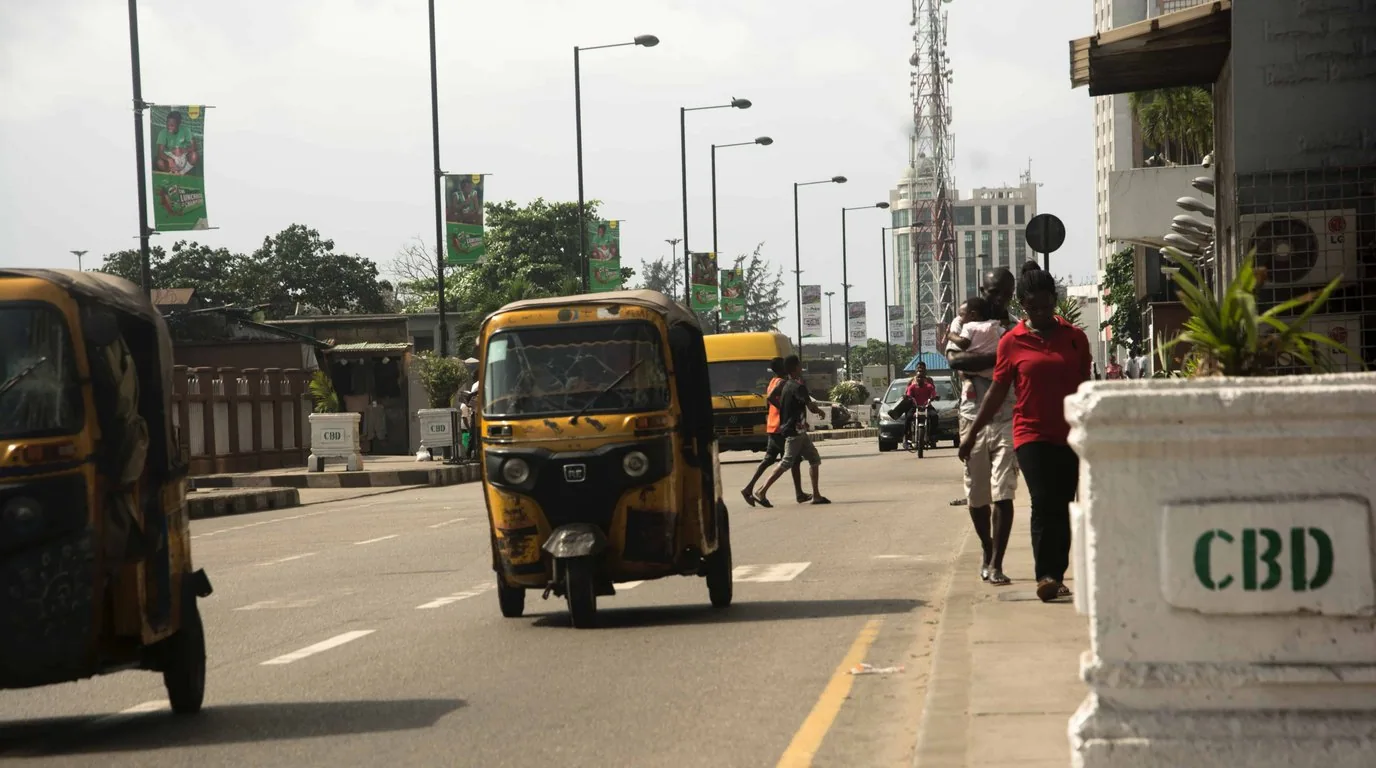
Lagos congestion, Kenyan city delivery, Ghanaian last mile: how duty turns into configuration
All three markets use cargo three-wheelers, but the road a vehicle works every day decides which capacity band it needs. Once the duty cycles are aligned the configuration differences follow — and that is also the answer to why no fixed quote is possible: one written-down amount cannot serve three duty cycles.
- Nigeria: congestion plus heavy load. Extreme stop-start is the norm in Lagos — up to 14 hours of operation a day, about nine stops per kilometre, 36–41°C ambient — and the BMS must absorb roughly 180A of instantaneous inrush without a false cut-out. The Nigerian requirement is therefore continuous discharge and transient over-current tolerance rather than raw capacity, which is why the desk leads on 60V / 72V 120–140Ah and steps to 72V 160–200Ah on loaded building-material routes.
- Kenya: city delivery plus coastal corrosion. Nairobi is dense point-to-point distribution, and Mombasa averages 88% humidity with heavy salt spray, so protection is part of the specification: anodised aluminium extrusion enclosures with a weather-resistant fluorocarbon coating and IP67 power and signal terminals to the salt-spray test basis. The sea leg is 18–22 days direct into Mombasa, then 8 hours on the SGR to Nairobi.
- Ghana: last mile plus market short-haul. Accra and Kumasi are dominated by wholesale market, building-material and supermarket distribution, modelled at six to eight trips of 8–15 km a day — roughly 60–120 km. Dry-season radiant surface heat, rainy-season standing water and unpaved rolling resistance inflate laboratory consumption by 35%–50%, so capacity has to be quoted on a road-resistance-corrected basis.
- Why no fixed quote: landed cost contains ocean and slot variability, destination inspection and certification routes, and the part of the configuration that moves with the duty cycle. Publishing one fixed amount would promise the same number to three completely different duty cycles and would not match the configuration at order stage. We therefore model from destination port, payload, daily distance and motor rating, and state plainly that the formal quotation governs.
Price and market-access questions across the three countries
Why does the same cargo tricycle battery cost so much more in one of these countries than another?expand_more
Can you simply give me a price range?expand_more
Who handles SONCAP (PC + SC) and Form M for Nigeria?expand_more
Is the Kenyan PVoC inspection done before shipment, or on arrival?expand_more
What certification does clearance at Tema in Ghana require?expand_more
What configuration do you recommend for each country?expand_more
Send four parameters, get a firm quote against your port
Give us destination port, rated payload, daily distance and motor rating and we will model FOB / CIF pricing for the matching capacity band, container stowage and lead time, with the document list your destination requires. A 20GP takes about 180 three-wheeler packs and a 40HQ more than 320; mixed specifications can be consolidated.
- Modelled per port — Lagos, Mombasa or Tema, inland leg included
- UN38.3 / MSDS / packing certificate with every container, access file per current regulations
- Standard models sample in 3–5 days; container orders ship with matched core consumables
Specification notice:The figures above are engineering reference values. They may differ with production batch, configuration and actual duty cycle, and the percentages for life, efficiency, availability and coverage are engineering estimates and bench references. Contact us for the detailed specification sheet.
Chassis dimensions, payload data and purchase volumes you submit stay strictly confidential. A mutual NDA can be signed first.