
Passenger tricycle battery packs:sized for passenger duty and nothing else
The daily distance on a passenger tricycle is short, but it is sliced into fragments: a loaded pull-away and climb at the morning peak, empty running in the afternoon, loaded again at the evening peak, with a “should I top up now” decision in between. That is why passenger duty cannot reuse the tonnage-based voltage logic of cargo work. This page covers passenger duty only: voltage and capacity by occupancy and daily distance, what a working day actually looks like, the trade-off between pack weight and paying passengers, and the questions lead-acid owners ask first.
verifiedConsumption and range figures are typical fleet averages on passenger duty with three passengers and the driver, not nameplate claims; gradient, surface, occupancy and riding style all move the result. The specification sheet shipped with your container governs.
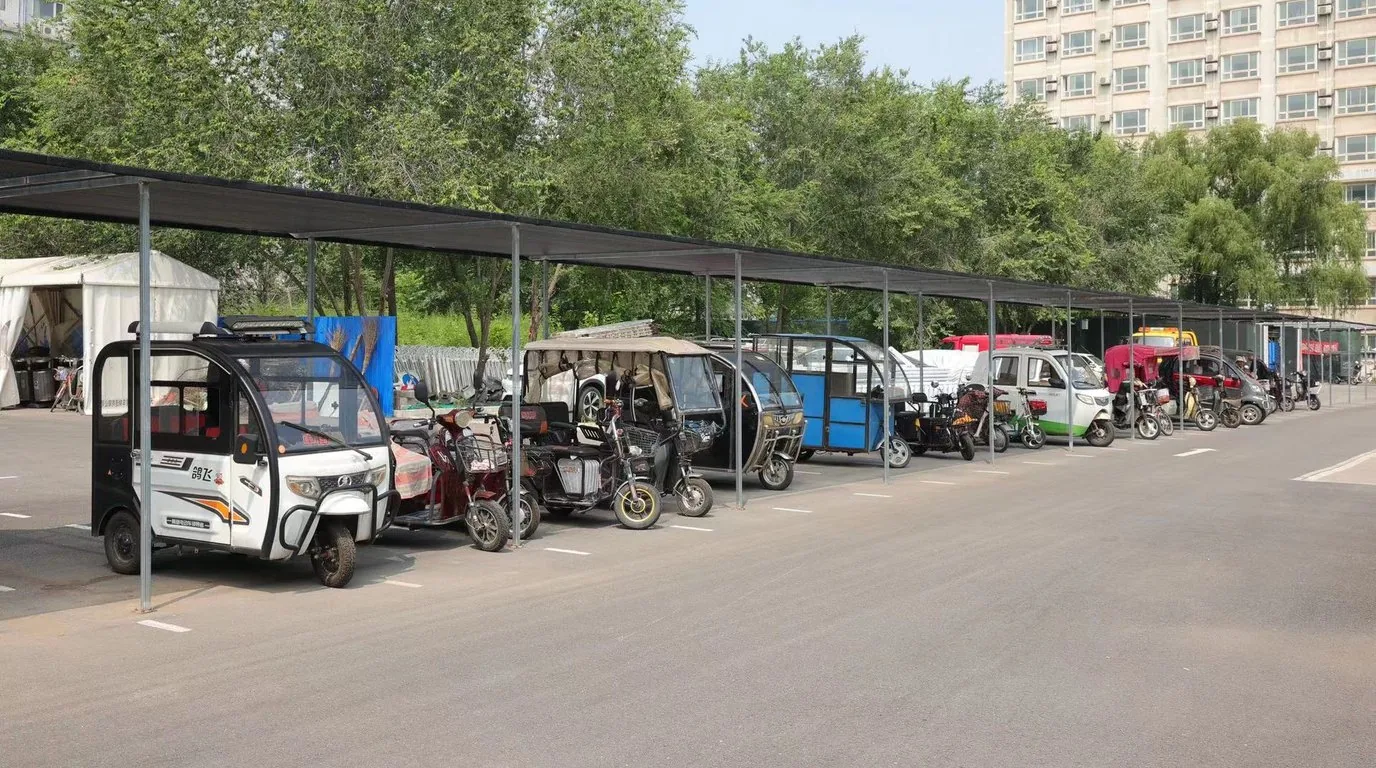
Four hard constraints that define passenger duty
Occupancy, stop-start density, daily distance and charging rhythm — those four set the shape of the sizing table. Quantify them and capacity stops being a guess.
Specification notice:The figures above are engineering reference values. They may differ with production batch, configuration and actual duty cycle, and the percentages for life, efficiency, availability and coverage are engineering estimates and bench references. Contact us for the detailed specification sheet.
Passenger sizing table: occupancy against 100 / 120 / 150 km a day
Standard duty: three passengers plus the driver, mainly paved surfaces and frequent stops. Consumption uses the published 55–68 Wh/km basis and range figures are averages rather than label claims. Size on real daily distance plus 20% margin.
| Daily distance | Normal occupancy | Recommended voltage / capacity | Nominal energy | Real combined consumption | Target range | Charging plan |
|---|---|---|---|---|---|---|
| 100 km / day | 4 people (3 passengers + driver) | 48V / 51.2V 100Ah | ≈ 5.12 kWh | 55 – 68 Wh/km | 100 – 120 km | One charge covers the shift; full charge overnight |
| 120 km / day | 4 people (3 passengers + driver) | 48V / 51.2V 120Ah | ≈ 6.14 kWh | 55 – 68 Wh/km | 110 – 130 km | Full charge overnight plus a 30–60 minute midday top-up |
| 150 km / day | 4 people (3 passengers + driver) | 72V 100Ah | ≈ 7.68 kWh | 65 – 80 Wh/km | 100 – 120 km | One mid-route top-up, timed away from peak tariff hours |
| 150 km / day | 5 people at full load (driver included) | 72V 130Ah | ≈ 9.98 kWh | 65 – 80 Wh/km | 110 – 130 km | One mid-route top-up plus a full overnight charge |
Why the 150 km step moves to 72V instead of simply growing the 48V capacity: a larger pack is a heavier pack, and on a passenger tricycle that weight comes straight out of paying seats. Raising the voltage also cuts bus current at the same shaft power, so the BMS is far less likely to limit current on a loaded climb — the real reason long passenger routes step up to 72V. The capacity derivation is set out in the capacity and range engineering guide.
Specification notice:The figures above are engineering reference values. They may differ with production batch, configuration and actual duty cycle, and the percentages for life, efficiency, availability and coverage are engineering estimates and bench references. Contact us for the detailed specification sheet.
One working day: from the morning peak to the night shift
Across a single day the same pack sees full load, empty running, congestion, radiant heat and a charging decision. Below is a typical 120 km passenger route — the pack steps in the table are derived from it.
- 01wb_twilight
05:30 Pre-departure: leaving on a full charge
Charged to 100% overnight, with SOC and pack temperature checked before departure. Tropical mornings already sit at 28–32°C, the band where LiFePO4 discharges most efficiently; the −20°C to 65°C operating window is there for day-night swings and cold-climate markets.
SOC 100% · pack temperature 28–32°C - 02groups
06:00–09:30 Morning peak: loaded climbs, dense stops
This is the highest-consumption stretch of the day: three passengers aboard, several stops per kilometre, gradients at bridges and flyovers. Pull-away inrush is exactly what the platform’s 150–250A continuous rating and 3C peak are for. The BMS current limit must be checked against loaded pull-away, or the vehicle will lose power mid-climb or trip protection.
Peak consumption window · roughly 30–35% of the pack - 03battery_charging_full
11:00–13:30 Midday: the top-up decision
Not needed at the 100 km step; at 120 km plan 30–60 minutes up to about 80%; at 150 km it is mandatory. The charger must be a CC-CV unit matched to the series count — passenger depots often run from the grid or a generator, so specify a 140V–280V wide-input charger with transient suppression.
Top-up window 30–60 minutes - 04traffic
16:00–20:00 Evening peak: where SOC anxiety peaks
The densest passenger demand of the day is also when a mid-route cut-out hurts most. That is what the 20% margin is for: below about 25% SOC the driver should be heading in or swapping vehicles, not “doing one more run” until the dashboard alarms. Coulomb-counting drift makes gauges read high, so quotes are issued on net usable capacity.
Hold a 20% margin · never run to the alarm - 05night_shelter
21:30 End of shift: overnight charge and next-day prep
Charge on return rather than leaving the pack at low SOC overnight. LiFePO4 accepts 1C charging, but in hot climates stay under 0.5C to protect cycle life; the BMS derates automatically with cell temperature. The pack is IP67 steel-enclosed with a potted BMS bay, so flood-prone roads and open-air parking are covered.
Charge under 0.5C · IP67 outdoor parking
A heavier pack costs you a passenger: the lead-acid weight bill
A passenger tricycle is not a cargo vehicle: extra pack weight cannot become extra goods, only one fewer passenger. The comparison is drawn at the same nominal capacity, 72V 150Ah; the 48V / 51.2V 100–120Ah steps common in passenger service are lighter on both sides, but the ratio is the same.
Factory lead-acid 6×12V 150Ah
About 72V 150Ah nominal- cancelAssembled weight≈ 240 kgRoughly three adults riding along permanently
- cancelEffect on seatsAt 4–5 people aboard the rear axle nears its limit, and drivers routinely turn one fare away
- cancelUsable capacityDischarged to only 50–60% to protect life — a 120 km day usually needs a top-up
- cancelCycle life300 – 500 cyclesOften under 300 on high-frequency stop-start passenger duty
- cancelVehicle attitudeHigher centre of gravity and heavier rear axle make potholes and speed humps harsher
72V 150Ah LiFePO4
Same nominal capacity · 24S LFP · Tier-1 A-grade cells- check_circleAssembled weight≈ 81 kgAbout 160 kg lighter — two adults’ worth of payload margin released
- check_circleEffect on seatsFull occupancy unrestrictedThe released weight goes back into seats and ride comfort
- check_circleUsable capacity88–90% DoD recommendedUsable capacity close to the label; one pack covers a passenger shift
- check_circleCycle life3,500 cycles1C charge/discharge to ≥80% SOH, 5-year / 3,500-cycle warranty
- check_circleVehicle attitudeLower centre of gravity and a lighter rear axle reduce impact and frame fatigue
The eight questions passenger tricycle owners ask first
Will one pack last a passenger tricycle a full day?expand_more
Which is worth more — losing one fare, or paying for the lithium upgrade?expand_more
How fast can a passenger tricycle go — does the battery hold it back?expand_more
Do I need a new controller and charger when leaving lead-acid?expand_more
What does a passenger tricycle battery cost?expand_more
Can it be built as a swappable pack?expand_more
My vehicle is lead-acid — can I convert directly?expand_more
What certifications does a passenger tricycle battery need to ship?expand_more
Once passenger duty is fixed, three things to check next
Keke Napep battery (West African passenger duty)
Also passenger duty, but 8–12 hour shifts in 45°C heat on rough surfaces — a different sizing table and clearance route.
See the West Africa optionarrow_forward48V platform specifications
The most common step for passenger work: capacity matrix, discharge capability and bay dimensions, including 51.2V 100–120Ah.
See the 48V platformarrow_forwardFleet TCO guide
Three-year TCO for lead-acid against automotive LiFePO4, cost per kilometre and the payback model — with lost fares included.
Open the TCO guidearrow_forwardGet passenger-tricycle sizing and pricing against your route
Send the destination port, normal occupancy, daily distance and motor rating. We will size the 48V / 51.2V or 60V / 72V pack, and return FOB / CIF pricing, container allocation and delivery schedule with the shipping document list attached.
- Sizing advice and pricing within 24 hours on working days
- Sample packs can prove the real passenger duty cycle before you commit to a container
- Fleet size, routes and market-access documents are strictly confidential; NDA available first
Specification notice:The figures above are engineering reference values. They may differ with production batch, configuration and actual duty cycle, and the percentages for life, efficiency, availability and coverage are engineering estimates and bench references. Contact us for the detailed specification sheet.