
Why an e-rickshaw battery dies by midday:six causes ranked by likelihood, with the test for each
The conclusion first: when a tricycle leaves on a full charge and cuts out by midday, the cause is usually not a failed battery. In our overseas service tickets the distribution is over-current protection (OCP) 38%, cell voltage delta 27%, thermal derating 18% and comms loss 17% — and only part of that is genuinely short capacity.
The correct order is: ① reverse-check how many Ah the daily distance actually needs, to separate a sizing error from ageing; ② check for lead-acid ageing (capacity collapse after 300–500 cycles); ③ check heat derating; ④ check whether charging ever completes; ⑤ check the BMS protection thresholds; ⑥ check cell internal-resistance consistency. The first four can be settled on the ground with a multimeter, an infrared thermometer and a charging log. Only the sixth needs cell-level testing.
verifiedThe fault distribution comes from overseas service tickets. Every protection threshold quoted is the production motive-grade BMS firmware default and can be tuned to a specific duty cycle.
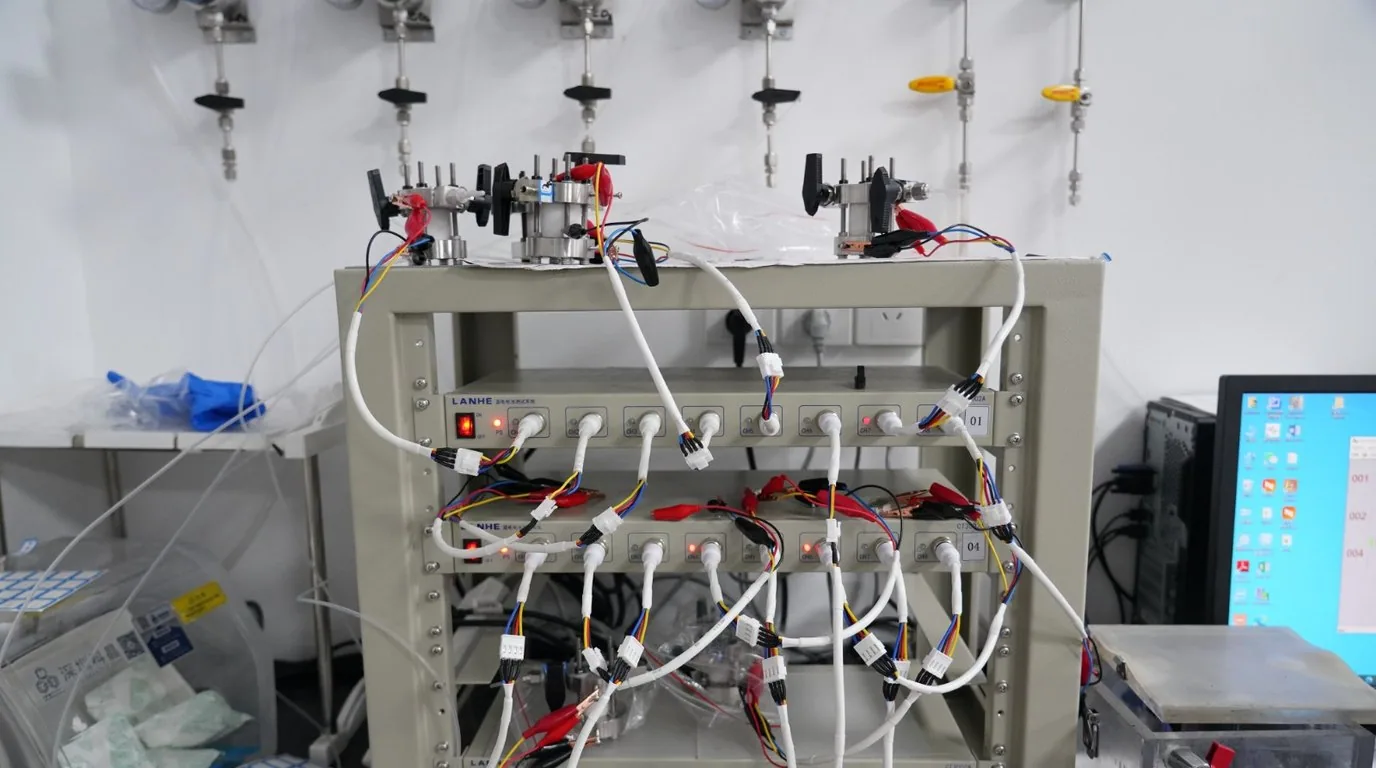
The six causes in order: how to test each one, and what to do
Work through them in sequence — do not skip. The first three explain most midday failures and none of them requires opening the pack. Never open a pack or swap cells before you have baseline measurements.
- 01straighten
The capacity was never enough: reverse-check the Ah you need
How to test: turn the daily distance into energy, then divide by the platform nominal voltage to get the Ah the day genuinely consumes.
Tools: calculator + a true daily-distance log
· 120 km a day at passenger consumption of 55–68 Wh/km = 6.6–8.2 kWh;
· 51.2V (16S) platform → 129–160Ah, which lands on the 150Ah step;
· 76.8V (24S) platform → 86–106Ah, which lands on the 100Ah step.
If the answer is a step or more above the pack on the vehicle, the fault is sizing, not quality.
What to do: move up a step (or size on real daily distance plus about 20% margin). Heavy cargo consumes 95–125 Wh/km, so the same distance needs far more Ah than the passenger figure — never size a cargo vehicle on a passenger basis. - 02autorenew
Lead-acid ageing: capacity collapse after 300–500 cycles
How to test: three signals together confirm it. ① The bank is more than a year old and charged once per day, so it is approaching 300–500 cycles. ② Charging time has shortened noticeably — the same charger used to take 8 hours and now turns green in 5, which means less energy is going in. ③ The first stretch after a full charge already drops bars, with the first 20% of SOC falling especially fast.
Tools: charging-time log + first-leg range after full charge
On high-frequency stop-start passenger duty with deep discharge, real lead-acid life is often below 300 cycles.
What to do: the loss is irreversible; equalising and watering only delay it. Either replace the bank or convert to LiFePO4, which delivers about 1.7x the usable energy of a same-label lead-acid set at 3,500 cycles @1C to ≥80% SOH. - 03device_thermostat
Heat derating: output is being limited above 40°C
How to test: ① Run the same route at dawn and at midday; if range differs by more than about 10%, the cause is temperature rather than fade. ② Take an infrared thermometer over the battery bay immediately after a midday run — clearly above ambient with local hot spots means the bay cannot shed heat (a 50°C road surface plus a sealed metal bay routinely pushes internal temperature to 58–62°C). ③ Read the BMS log: thermal derating is a hard firmware action, holding current at 50% above 55°C and cutting discharge entirely above 65°C.
Tools: thermal imaging camera + BMS temperature log
What to do: this is protection, not a fault. Recover range by managing heat: a reflective layer in the bay, forced-convection ducting, no heavy charging at midday, and charge rate held under 0.5C. - 04power
Charging never completes: no CC-CV, or not enough time
How to test: ① Check the charger model — if the original lead-acid constant-voltage unit is still in use, the problem is almost certainly here: it has a high-voltage equalisation and float stage, its output sits well above the LiFePO4 saturation voltage, and it has no CC-CV handshake with the BMS, so it drives the pack straight into protection. ② Read the gauge the moment the light turns green: about 95% means one cell reached 3.65V first, tripped cell over-voltage protection and ended the charge early. ③ Check the charging time against the capacity (formula in the charging-time article).
Tools: charger nameplate + gauge reading after full charge
What to do: fit a CC-CV charger matched to the series count (±0.05V knee accuracy), and leave it connected for one to two hours after the green light so the BMS balancing circuit can trim the delta. - 05bolt
BMS threshold mismatch: it is not flat, it was cut off early
How to test: the single cause most often misread as "dead battery". Three signatures: ① it recovers about 5 seconds after the throttle is released, or needs the charger plugged in before it powers up; ② it cuts out with three bars left, and the gauge rebounds as soon as the charger is connected; ③ on a loaded pull-away test (rear wheel propped, brake held, full throttle for 2 seconds), if bus sag stays under 4.5V and it still cuts out, the cells are healthy and the BMS transient current threshold is simply set too low.
Tools: clamp meter for peak current + BMS freeze frame (ERR-02: Peak-OCP)
The root cause is a storage-grade BMS: under full load the motor demands 3–4x its rated current (a field capture recorded 192.4A of inrush), while a storage board is often clamped at 80–100A, so the MOSFETs cut the circuit within a few tens of milliseconds.
What to do: move to a motive-grade BMS sized at continuous ≥ 1.5x the controller current limit, transient trip ≥ 3x, with a 2000–3000ms transient delay. The full threshold matrix and four-step SOP are in the uphill cut-off guide. - 06balance
Cell internal-resistance spread: one weak cell drags the string down
How to test: the classic weakest-link effect. ① Sweep all 16 or 24 cell voltages from the host software; a static delta above 30mV is the fault-warning tier (distinct from the 3mV factory matching tier and the 15mV assembled-pack tier). ② Watch the live voltage curve under load — the weak cell falls off a cliff (field measurement shows the dynamic delta stretching from 15mV at rest to 380mV loaded), hits the 2.50V under-voltage line first and hard-cuts the whole string. ③ Measure that cell with a milliohm meter; above twice the factory baseline it must be replaced.
Tools: USB-CAN host software + milliohm meter
What to do: first run active energy-transfer balancing with the factory balancer, or charge fully on a low-current charger and leave it connected for more than 8 hours so passive balancing keeps bleeding the high cells, until the pack delta returns to the ≤20mV safe window. At the factory the acceptance basis is cell spread ΔV ≤ 3 mV and internal-resistance spread ΔIR ≤ 0.5 mΩ — ask for both figures when you buy, instead of repairing them six months later.
Symptom lookup: decide in 30 seconds, and where to fix it
The six causes compressed into one field table. Match the symptom first, verify with the listed tool, and do not open the pack on a hunch.
| Symptom | Most likely cause | 30-second test | Where to fix it |
|---|---|---|---|
| Cut out at midday from new, never reached the quoted range | ① Capacity undersized | Daily distance × real Wh/km ÷ nominal voltage; is the result a step or more above the pack fitted? | Move up a step with about 20% margin; recompute cargo duty at 95–125 Wh/km |
| Over a year old, range shrinking month by month, charging faster | ② Lead-acid ageing (collapse after 300–500 cycles) | Compare charging time and first-leg range; months in service × daily cycles against 300–500 | Irreversible: replace the bank or convert to LiFePO4 at 3,500 cycles |
| Clears the route at dawn, dies halfway through it at midday | ③ Heat derating | Infrared the bay; check the BMS log for current limiting above 55°C or cut-off above 65°C | Reflective bay, forced-convection ducting, no midday charging, rate under 0.5C |
| Green light on but the gauge reads 95%, then falls fast all afternoon | ④ Charging never completes (no CC-CV / too short) | Identify the charger (lead-acid constant-voltage?); check time against capacity ÷ current | Fit a CC-CV charger (±0.05V knee) and leave it connected 1–2 hours past green |
| Cuts out with three bars left; recovers by itself or needs the charger | ⑤ BMS threshold mismatch | Loaded sag under 4.5V yet it still cuts out; read freeze frame ERR-02: Peak-OCP | Motive-grade BMS: continuous ≥1.5x limit, transient ≥3x, 2000–3000ms delay |
| Instant cut-out from full charge under load; charge level rebounds on the charger | ⑥ Cell internal-resistance spread | Sweep cell voltages: static delta above 30mV (fault-warning tier), dynamic delta reaching 380mV | Balance or replace the weak cell; ask for ΔV ≤ 3mV / ΔIR ≤ 0.5mΩ on new packs |
In ticket statistics the cause most often mislabelled as a scrap battery is ⑤. The protection thresholds, freeze-frame codes and four-step SOP are in uphill cut-off and BMS current limit diagnosis; field tooling and the three-step SOP are in the troubleshooting and field diagnostics centre.
Specification notice:The figures above are engineering reference values. They may differ with production batch, configuration and actual duty cycle, and the percentages for life, efficiency, availability and coverage are engineering estimates and bench references. Contact us for the detailed specification sheet.
Rather than wait for failure, ask for these four figures when you buy
Four of the six causes are decided at the factory: the capacity basis, the cell grade, the BMS thresholds and the cell consistency. All four figures already exist at dispatch — buyers simply rarely ask for them. The acceptance limits are public: voltage spread, resistance spread, cycle life and capacity retention can all be written into the specification.
- Cell voltage spread ΔV ≤ 3 mV: the outgoing static delta decides whether a weak cell stalls the whole string two years later.
- Internal-resistance spread ΔIR ≤ 0.5 mΩ: resistance scatter is what lets the dynamic delta run away under high current, so ask for it on any heavy-load duty.
- 3,500 cycles @1C to ≥80% SOH: require the test conditions (rate, DoD, temperature) to be stated — a bare "3,000 cycles" with no conditions is not evidence.
- The charger-to-BMS handshake document: confirm CC-CV and that the charger reads the BMS permitted current, so a lead-acid constant-voltage unit never drives a new pack into protection.
- Never short BMS P- to B- to keep a vehicle moving: it bypasses all semiconductor protection, and with the cell-level second line removed an external short leads straight to fire.
- Ballast the vehicle to rated payload when reproducing the fault — an empty tricycle cannot reproduce loaded pull-away inrush and will not show the real cause.
- Record before you open anything: static pack voltage, cell voltages, charging time and bay temperature, all four, before deciding to open the pack.
Five follow-up questions about a midday cut-out
My vehicle is only three months old and already dies by midday — is it a battery defect?expand_more
It recovers a few seconds after I release the throttle — what does that mean?expand_more
My lead-acid bank is two years old and down to half its range — is it worth repairing?expand_more
Will a fan or removing the bay cover fix the heat-related range loss?expand_more
How do I find which cell string is behind without opening the pack?expand_more
Send the fault profile and we will locate it from the data
Give us the voltage platform and capacity, the daily distance, the charging time, the cut-out behaviour (self-recovering, or does it need the charger) and the measured bay temperature. Our powertrain engineers return a fault-level decision and a handling plan within 24 hours on working days.
- Decide first whether it is sizing, fade, derating, charging or a protection threshold — then whether a pack change is needed at all
- USB-CAN host software and BMS freeze-frame interpretation support available
- Fleet size and route data are strictly confidential; NDA available first
Specification notice:The figures above are engineering reference values. They may differ with production batch, configuration and actual duty cycle, and the percentages for life, efficiency, availability and coverage are engineering estimates and bench references. Contact us for the detailed specification sheet.