
24V and 36V LiFePO4 battery packs:one selection logic for the low-voltage platform
The difference between the low-voltage platform (24V / 36V) and the 48V-and-above steps is not the cell — it is fewer series cells, fewer parallels and a voltage spread that is far easier to balance. A low-voltage pack is lighter, smaller and easier to fit into a down tube or seat post, at the cost of higher bus current and higher line loss for the same energy. That makes it a fit for light, low-speed duty with a limited daily distance. This page covers 24V (8S) and 36V (12S) together: voltage windows, capacity matrix, vehicle fit and whether a 36V lead-acid 3×12V bank can be swapped directly.
verifiedVoltage windows use the same per-cell basis as the 16S and 24S platforms on this site (3.2V nominal, 3.65V full charge); figures are typical values at 25°C and the signed specification sheet governs.
What the low-voltage platform delivers
Specification notice:The figures above are engineering reference values. They may differ with production batch, configuration and actual duty cycle, and the percentages for life, efficiency, availability and coverage are engineering estimates and bench references. Contact us for the detailed specification sheet.
24V (8S) and 36V (12S) capacity matrix by vehicle
Energy is computed at 25.6V and 38.4V nominal. On a small low-voltage pack the enclosure and BMS take a larger share of the mass, so assembled weight is quoted at roughly 7–9 kg/kWh including the steel case, BMS and harness. Measure the bay first, then choose capacity by daily distance.
| Capacity | Nominal energy | Pack weight (typical) | Typical vehicle | Target range | Reference pack model |
|---|---|---|---|---|---|
| 24V 20Ah | ≈ 0.51 kWh | ≈ 4.0 kg | Pedal-assist e-bike, folding bike | 20 – 30 km | VT-2420-EBIKE |
| 24V 30Ah | ≈ 0.77 kWh | ≈ 6.0 kg | Pedal-assist e-bike, light scooter | 30 – 45 km | VT-2430-EBIKE |
| 24V 40Ah | ≈ 1.02 kWh | ≈ 8.0 kg | Small scooter, resort shuttle | 40 – 60 km | VT-2440-SHUTTLE |
| 24V 60Ah | ≈ 1.54 kWh | ≈ 12 kg | Site patrol / shuttle, small storage | 55 – 75 km | VT-2460-SHUTTLE |
| 36V 10Ah | ≈ 0.38 kWh | ≈ 3.5 kg | Light city commuter e-bike | 15 – 25 km | VT-3610-EBIKE |
| 36V 15Ah | ≈ 0.58 kWh | ≈ 5.0 kg | E-bike, compact folding bike | 25 – 35 km | VT-3615-EBIKE |
| 36V 20Ah | ≈ 0.77 kWh | ≈ 6.5 kg | Long-range e-bike, small scooter | 30 – 45 km | VT-3620-EBIKE |
| 36V 30Ah | ≈ 1.15 kWh | ≈ 9.0 kg | Light scooter, resort shuttle | 45 – 70 km | VT-3630-SHUTTLE |
| 36V 40Ah | ≈ 1.54 kWh | ≈ 12 kg | Light cargo two-wheeler, site shuttle | 60 – 90 km | VT-3640-DELIVERY |
Range is converted at 15–25 Wh/km for light, low-speed duty, including the 88–90% DoD, loaded retention of 94.5–96.0% and tropical derating factor of 0.91–0.94. The site's 60V high-frequency delivery figure is 28–35 Wh/km at a higher payload and speed, so the two are not directly comparable. The full model is in the real capacity and range guide.
Specification notice:The figures above are engineering reference values. They may differ with production batch, configuration and actual duty cycle, and the percentages for life, efficiency, availability and coverage are engineering estimates and bench references. Contact us for the detailed specification sheet.
24V or 36V: the same low-voltage class, but not competing steps
These are two duty envelopes rather than two price tiers. 24V suits assist-led duty with a lift-out pack and short daily distances; 36V suits direct-drive light two-wheelers and site vehicles cruising at 20–30km/h. Picking wrong does not usually mean the vehicle will not move — it means either the pack cannot deliver (voltage too low, controller dropping into under-voltage protection) or a heavier 36V pack is carried on a vehicle that only ever needed 24V.
- Choose 24V when the vehicle is designed around 24V (assist bikes, mobility scooters, site carts and small storage), the motor is 500W or less, the controller under-voltage point sits near 21V and daily distance stays inside 30km.
- Choose 36V for an existing 36V vehicle, or a light two-wheeler, light scooter or site shuttle targeting 20–30km/h at 350–1000W with 30–70km a day.
- Do not push a 24V vehicle to 36V: a 12S pack reaches 43.8V at full charge, beyond the rating of the original 24V controller and cluster input, and it endangers the gauges, lighting and DC-DC.
- Do not push a 36V vehicle to 48V: crossing out of the below-60V safety extra-low-voltage zone upgrades insulation, creepage and BMS isolation requirements together, and the retrofit usually costs more than fitting a larger 36V pack.
- Controller under-voltage point and MOSFET rating must cover the full-charge voltage (29.2V / 43.8V) and the light-load cut-off together
- Cluster and DC-DC input range: the 36V step sits 2.4V above lead-acid nominal, so confirm the 12V step-down module accepts 43.8V
- Bay clearance and handle footprint: most low-voltage packs are lift-out, so allow for the handle, lock body and connectors
- Charger: a CC-CV charger for the correct series count is mandatory — never continue with a lead-acid constant-voltage unit
Both are labelled 36V — where lead-acid 3×12V and 12S LiFePO4 diverge
Factory lead-acid 3×12V 20Ah
About 36V 20Ah nominal- cancelNominal / full charge36V / ≈ 43.5VThree 12V blocks in series, each charged to about 14.4–14.7V
- cancelNominal energy≈ 0.72 kWhComputed at 36V × 20Ah
- cancelAssembled weight≈ 19 – 22 kgEach 12V 20Ah block is about 6.5–7kg
- cancelUsable capacityDischarged to only 50–60% to protect life: roughly 10–12Ah usable from a 20Ah label
- cancelCycle life300 – 500 cyclesOften under 300 under deep discharge
- cancelCharge gaugeInfers state of charge from voltage, so the bars read wrongly once lithium is fitted
36V 20Ah LiFePO4
Same nominal capacity · 12S LFP- check_circleNominal / full charge38.4V / 43.8V (12S)Full charge lands inside the lead-acid charge window — which is exactly why a direct swap works
- check_circleNominal energy≈ 0.77 kWhSlightly higher at the same nominal capacity
- check_circleAssembled weight≈ 6.5 kgAbout 13 kg lighter than the equivalent lead-acid bank
- check_circleUsable capacity88–90% DoD recommendedUsable capacity close to the label
- check_circleCycle life3,500 cycles1C charge/discharge to ≥80% SOH; 5-year / 3,500-cycle warranty
- check_circleCharge gaugeSOC comes from the BMS, readable over a Bluetooth app or a CAN / RS485 cluster
Swapping lead-acid 3×12V for a 36V lithium pack: four checks
A 36V lead-acid bank of three 12V blocks is the classic direct-swap case among low-voltage strings: both the operating window and the full-charge voltage fall inside the 12S LiFePO4 range. A direct swap, however, is not a no-change swap — work through all four checks below.
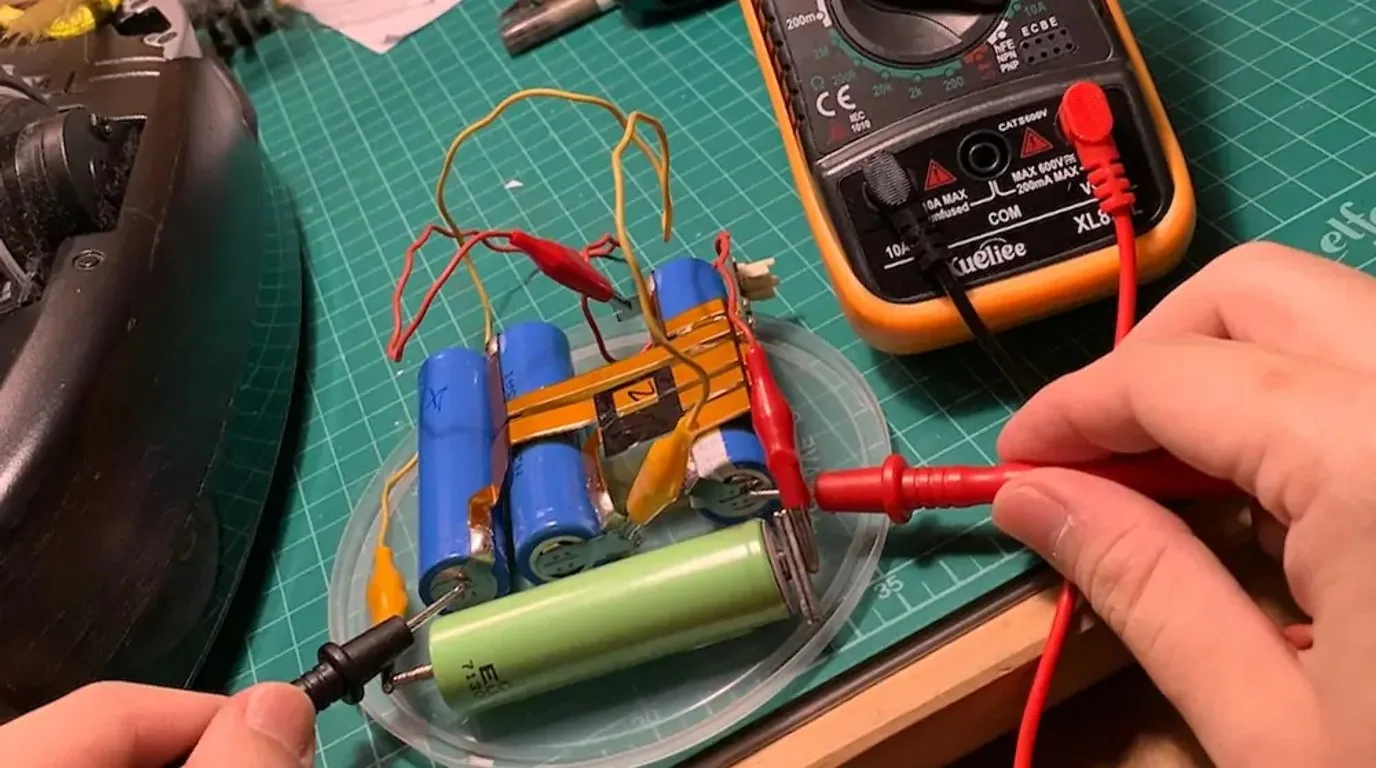
- 01multimeter
Step 1 — Confirm the voltage windows overlap
Record the original lead-acid full-charge voltage and the controller under-voltage point. Three lead-acid blocks reach about 43.5V at full charge and the controller cut-off usually sits near 31.5V; 12S LiFePO4 is 38.4V nominal, 43.8V full charge and about 30V recommended discharge cut-off, so the windows broadly overlap and most controllers can stay. If the original cut-off is set above 33V it will trip early and must be recalibrated.
Lead-acid 3×12V full charge ≈ 43.5V / 12S LFP full charge 43.8V - 02charger
Step 2 — Replace the lead-acid charger
A lead-acid charger carries a de-sulphation high-voltage pulse stage and a float stage whose termination voltage does not match 12S LiFePO4. It drives the pack straight into over-voltage protection and, over time, stretches the cell voltage spread. A 12S CC-CV charger is mandatory. Charger matching rules are in the charger matching and fast-charge safety guide.
The one component that must change - 03dashboard
Step 3 — Check the cluster and DC-DC input range
A 36V lead-acid platform is nominally 36V while 12S LiFePO4 is 38.4V nominal, and the 43.8V full charge is close to the lead-acid figure. Most 36V clusters and 12V step-down modules accept it, but confirm each one: a cluster that infers charge from a lead-acid voltage curve will read full for the first 80% of every trip.
2.4V higher nominal, 0.3V higher at full charge - 04straighten
Step 4 — Check the bay and the connector polarity
A lithium pack is usually smaller than the lead-acid bank at equal capacity, but allow for the handle, lock body and connector footprint. Power terminal polarity frequently differs from the factory loom, and reverse connection destroys both the BMS and the controller. The full dimension and polarity checklist is in the replacement battery bay lookup.
The lithium pack is usually smaller at equal capacity
24V and 36V lithium battery questions we get every week
How do I choose between 24V and 36V?expand_more
Can lead-acid 3×12V be swapped directly for a 36V lithium pack?expand_more
How far will a 36V pack take me?expand_more
What vehicles actually run 24V and 36V?expand_more
How much range and life do I gain by switching to lithium?expand_more
Do I need a new controller after switching to lithium?expand_more
Can the low-voltage platform be built as swappable, with communications?expand_more
Three things to check once the voltage is fixed
Step up to the 48V platform
The 16S LiFePO4 (51.2V / 58.4V) capacity matrix for light passenger duty, including the swap-cabinet communication build.
See the 48V platformarrow_forwardLead-acid to lithium upgrade
Range gain at equal capacity plus the controller and charger compatibility checklist, including 36V lead-acid swaps.
See the upgrade patharrow_forwardVoltage selection decision tree
Work back from vehicle, power and payload to a voltage platform, with calculated current, copper loss and efficiency deltas.
Open the selection guidearrow_forwardGet a firm 24V / 36V quotation for your vehicle and bay
Send the vehicle voltage platform, battery bay length × width × height, payload, daily distance and motor rating, and we will model FOB / CIF pricing, container allocation and the shipping document list.
- Selection advice and pricing within 24 hours on working days
- Sample packs available to prove fit and duty cycle before committing to a container
- Vehicle parameters and market-access documents are strictly confidential; NDA available first
Specification notice:The figures above are engineering reference values. They may differ with production batch, configuration and actual duty cycle, and the percentages for life, efficiency, availability and coverage are engineering estimates and bench references. Contact us for the detailed specification sheet.