
Battery swapping station:getting a site from selection to operation
People searching for a battery swapping station fall into two groups: those working out whether the business pays, and those working out how to build the thing. This page answers only the second question — how to select the site, how to size the standby pack count, why the charge rate decides your queue, how a cabinet handshakes with a pack, and which power and fire conditions a site has to meet. Payback, fleet partnership and franchise models are set out line by line on the battery swapping solutions page; none of it is repeated here.
verifiedPower capacity, fire and security requirements are governed by local electrical and fire codes; this page gives engineering calculations and typical pack figures, not a local-code ruling.
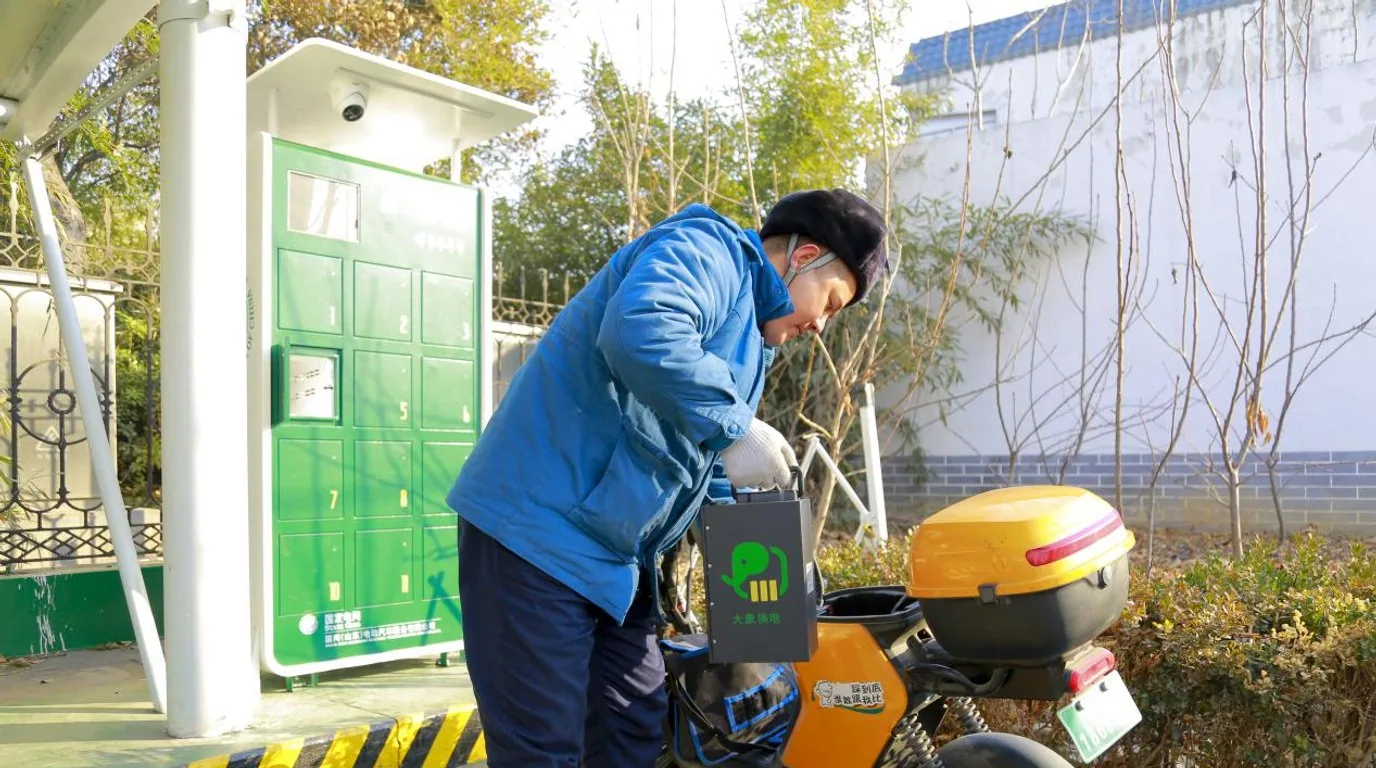
Four figures a station is designed around
Specification notice:The figures above are engineering reference values. They may differ with production batch, configuration and actual duty cycle, and the percentages for life, efficiency, availability and coverage are engineering estimates and bench references. Contact us for the detailed specification sheet.
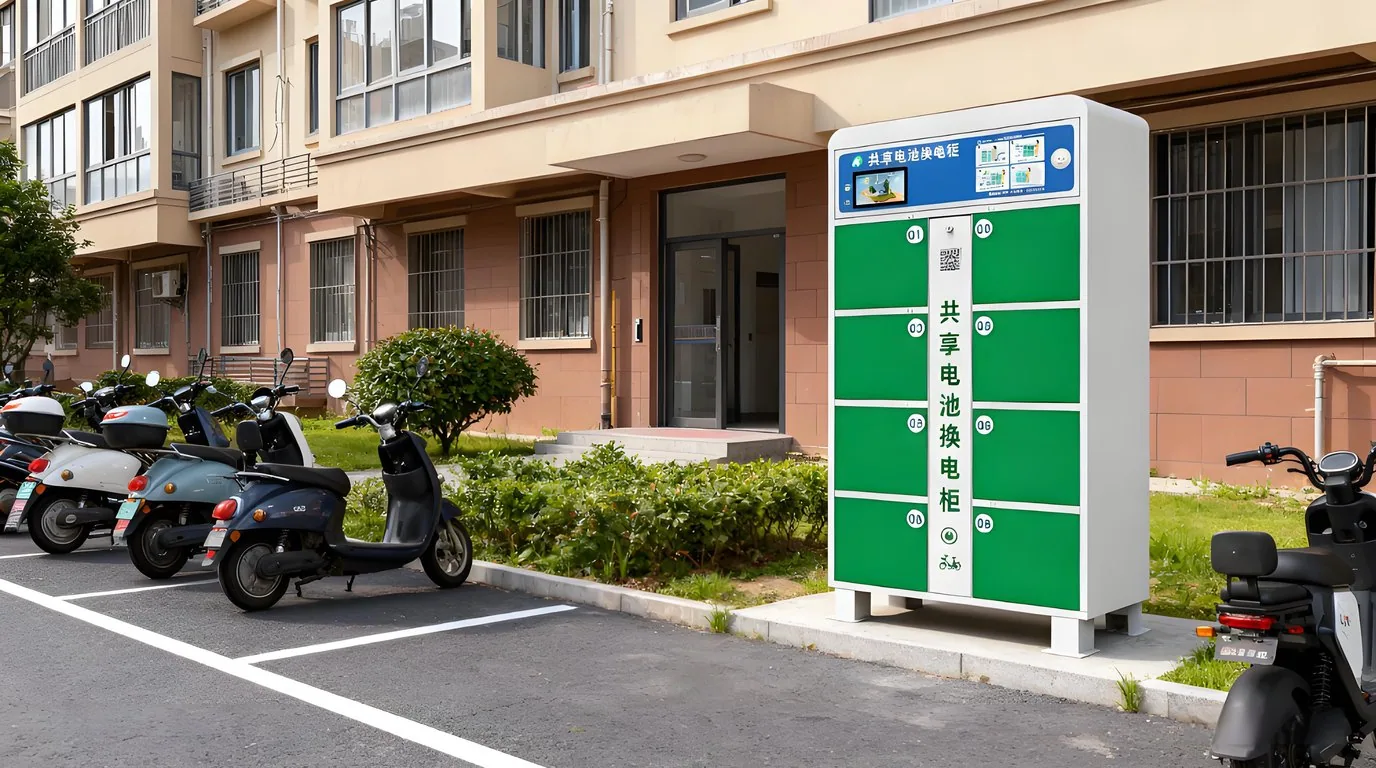
Site selection: measure four hard conditions before you discuss rent
Of the four siting variables, only rent is negotiable. The other three are physical constraints: traffic, site conditions, power capacity and accessibility. Measure the first three, then decide whether the location justifies the rent — reverse that order and every later item on the cost stack is dragged down by the siting decision.
- Traffic: count where the fleet eats — rider muster points, delivery depots, tricycle stands, market and filling-station entrances. Log operating vehicles per hour at peak, counting two- and three-wheelers separately. Do not infer it from footfall.
- Site conditions: cabinet and building formats place different demands on the base, canopy, vehicle flow and pack staging area. Check ground load capacity, drainage and turning radius before signing.
- Power capacity: the item most often discovered after signing. Charger demand follows the standby pack count and the charge rate (next section); add lighting, CCTV and cooling load, then compare against transformer headroom to decide whether an upgrade or a dedicated circuit is needed.
- Accessibility: is the site on the rider’s or driver’s natural route? The exchange takes 30 seconds, but if entering the site costs a two-kilometre detour, no exchange speed will hold the fleet.
- Operating vehicles per peak hour, two- and three-wheelers logged separately
- Usable site dimensions, ground load capacity, drainage and a viable canopy position
- Existing transformer capacity, incoming cable cross-section and available upgrade headroom
- Vehicle flow: parking position, and whether entering requires reversing or a U-turn
Sizing the standby packs: daily swaps ÷ daily turnarounds per pack
This is the figure stations most often get wrong. Standby pack count is not “more is safer”: every surplus pack is capital tied up, and it also pushes up the power capacity you have to secure.
| Item | Basis | How to estimate it | Worked value |
|---|---|---|---|
| Daily swaps | Vehicles served × swaps per vehicle per day | Delivery two-wheelers commonly 1–2 a day; passenger tricycles matched to 100–150 km a day | Use your own fleet, not another operator’s station data |
| Recharge time per pack | Converted from the charge rate | About 70 minutes at 1C; extrapolated to roughly 3.5 hours at 0.33C | Follows the charge rate you specify |
| Daily turnarounds per pack | Operating hours ÷ recharge time per pack | About 6 at 8 h, about 10 at 12 h, about 13 at 16 h (rounded down) | Also capped by the number of charging bays |
| Standby pack count | Daily swaps ÷ daily turnarounds per pack | Round up, then add a margin for peak concentration | Markets with twin peaks need the larger margin |
Turnarounds are capped by the number of charging bays — they are not unlimited. With four bays, 12 operating hours and 1C charging, the station’s usable throughput is set by the combination of bays and turnarounds; anything beyond it turns straight into queuing. Size bays and standby packs in the same calculation.
Specification notice:The figures above are engineering reference values. They may differ with production batch, configuration and actual duty cycle, and the percentages for life, efficiency, availability and coverage are engineering estimates and bench references. Contact us for the detailed specification sheet.
A queue means too few packs, never a slow exchange
Low charge rate + packs estimated by feel
Same daily swap count- cancelRecharge per pack≈ 3.5 hours at 0.33CExtrapolated on the same basis: a third of the rate triples the recharge time
- cancelDaily turnaroundsAbout 3 at 12 operating hoursTurnarounds fall in inverse proportion to recharge time
- cancelStandby packsThe same daily swap count needs several times the packs, pushing up both capital and power capacity
- cancelWhat riders seeThey arrive and there is no charged pack — a queue. More staff or more windows do not fix a pack shortage
1C high-rate + packs sized by formula
Same daily swap count- check_circleRecharge per packAbout 70 minutes at 1CRoughly 70% in 30 minutes
- check_circleDaily turnaroundsAbout 10 at 12 operating hoursAvailable turnarounds when bays are sufficient
- check_circleStandby packsWorked back from the formulaDaily swaps ÷ daily turnarounds, then a peak margin
- check_circleWhat riders seeA 30-second exchangeQueuing appears only in the true peak, absorbed by margin and bay count
Site works in order: power → fire → handshake → trial operation
These four steps run in sequence. Fix the power capacity or the cabinet cannot be installed; clear the fire plan or the site cannot open; complete the handshake or no number of packs can be exchanged.
- 01electrical_services
Size and connect the power supply
Work out total charging power from the standby pack count and charge rate, add lighting, CCTV, cooling and payment terminals, and you have the site demand. Compare it with transformer headroom and incoming cable cross-section to decide whether an upgrade or a dedicated circuit is required. Three-phase entry, breaker selection, residual-current and equipotential bonding follow local electrical codes and the utility’s requirements — we supply the electrical data for pack and cabinet, not a ruling on your local code.
First, and the most frequent source of rework - 02local_fire_department
Fire and security requirements
A lithium site’s fire plan usually involves fire compartmentation or separation distance, smoke, heat and combustible-gas detection, extinguishing media selection, emergency shutdown and evacuation routes. The actual thresholds follow local fire codes and acceptance requirements and we do not rule on them for you. What we can state from the product side: the swap pack is IP67 steel-enclosed with a potted BMS bay, the BMS cuts the MOSFET protection loop at about 65°C, and the operating window is −20°C to 65°C with high-temperature derating and cold-current limiting. Cabinet layout allows spacing for pack dimensions, the cooling path and service access.
Thresholds follow local fire codes - 03cable
Cabinet and pack handshake commissioning
Align the protocol, stepped charge-current delivery and fault codes item by item (expanded in the next section). We recommend proving the handshake on the bench with sample packs before installing the full station, so a data gap is not discovered after every cabinet is bolted down.
Register whitepaper + SDK + firmware engineer - 04monitor_heart
Trial operation and pack-count review
During trial operation, re-check the standby pack count against the real daily swap figure and peak distribution: if it is higher than modelled, add packs or raise the rate; if lower, move the surplus packs to another station. Standby pack count is an operating parameter corrected from data, not a one-off purchase number.
Corrected against real daily swaps
Cabinet to pack handshake: four things to align
An in-house cabinet needs no hardware change — line up the four items below and the handshake is done.
Communication interfaces: CAN 2.0B / RS485 / UART
The swap pack BMS integrates CAN 2.0B, RS485 and UART hardware interfaces natively and connects directly to mainstream IoT cabinet buses. The CAN side uses 29-bit extended identifiers to ISO 11898-2 and loads straight into a Vector CANoe .DBC database.
Register whitepaper: stepped charge current and fault codes
A complete communication register whitepaper defines stepped charge-current delivery, SOC and cell-voltage reporting, the handshake sequence and fault codes. On the RS485 / Modbus-RTU side we publish register addresses with function codes 0x03 / 0x06 / 0x10 and a complete CRC16 checksum library.
C/C++ SDK and cloud interface
A C/C++ SDK lets the cabinet controller integrate directly; where a cabinet settles through the cloud, the 4G-IoT MQTT / HTTP interface carries SOC, cycle counts and GPS tracks into your own server, so the data is not locked into a third-party platform.
Firmware engineer for joint commissioning
We assign a firmware engineer to support cabinet handshaking, stepped charge-current delivery and fault-code commissioning. Swap packs can be built to your cabinet interface with custom handshake logic, pack outline and shell marking.
Building a battery swapping station: what operators ask
What does a battery swapping station cost?expand_more
How many packs should one station hold?expand_more
How much space does the site need?expand_more
How much power capacity do we need to apply for?expand_more
How do we fix queuing?expand_more
How does the franchise work?expand_more
Our swap cabinet is in-house. Will the packs talk to it?expand_more
How long until the station pays back?expand_more
Beyond station engineering, three pages to follow
Swap business model and payback
The four-item cost stack, the daily swap basis, the conditions behind a 6–8 month payback, and four fleet and franchise models.
See the swap solutions pagearrow_forwardThe swappable pack standard
Quick-release structure, handle and keyed guide slot, 4G Cat.1 + GPS cloud lock-out and the cabinet handshake basis.
See the swap pack standardarrow_forwardOverseas hubs and spare parts
Seven directly managed hubs, a 2% core spares kit per container, 4G-IoT cloud diagnosis and local replacement — what keeps a station running.
See the hub networkarrow_forwardScope the station against your site and get whole-station pricing
Send the station format (cabinet or building), the vehicles you intend to serve, the pack capacity class and the local power connection. We will model the standby pack count, the charging bay layout, whole-station investment and FOB / CIF pricing, with the document and spares list attached.
- Station engineering advice and pricing within 24 hours on working days
- Sample swap packs plus the protocol whitepaper can prove the cabinet handshake before full installation
- Site locations, fleet size and protocol data are strictly confidential; NDA available first
Specification notice:The figures above are engineering reference values. They may differ with production batch, configuration and actual duty cycle, and the percentages for life, efficiency, availability and coverage are engineering estimates and bench references. Contact us for the detailed specification sheet.